
Checked 19 October 2026
Clearance lots and older stock: what time on a shelf does to new goods
Clearance tells you about the seller's warehouse. The condition of the piece depends on how long it sat there.
Clearance and storage on the condition scale
On the condition scale, 清仓 (clearance) usually covers "New, sizes thinning out" to "New, wrapping or tags disturbed". The four points below are the short version of this page; the sections after them go into each one.
Older stock, the second label on this page, spans from "New, every size still there" to "New, wrapping or tags disturbed", because storage time varies so much.
What usually differs. Goods the seller wants gone: an earlier colour, a style being dropped, whatever sizes remain. Usually new, but the size range is often thin and one page may carry several older styles at once.
What the CNFans defect check tends to do. Clearance names a sales condition, not a quality grade. Compare the exact option, count and declared condition, and ask about storage or visible damage when those details matter.
Photos that show it. A photo of the exact colour and style you are picking from the option menu, because mixed pages sometimes reuse one image across several options.
Questions before you pay. Is the photo the exact colour and style I am choosing? Which sizes are left? Is this fresh stock, or stock that has been sitting in storage?
Clearance lots and older stock
清仓 means clearing the warehouse. Related words are 甩卖 (selling off), 特卖 (special sale) and 降价 (price cut). 库存 means stock, and as a markdown reason it usually signals goods that have been held for a while, often an earlier style or colour, sometimes described as 旧款, an older style.
Both labels describe the seller's situation rather than the item. The seller needs the space or the cash; the goods are usually new. Taobao's own rules draw the same line from the other side. Its new-product rule, revised most recently on 30 June 2025, says an item qualifies as a Taobao new product only if it is not an older style relisted and its information contains none of a list of words that includes 特卖, 清仓, 降价, 甩卖 and outlet. In other words, a clearance listing and a new-in badge cannot sit on the same item.
Because clearance explains the price and not the condition, what you are really reading on these pages is time: how long the goods have waited, and what waiting does to cloth.
One page, several older styles
Clearance pages often bundle what is left of several styles under one listing, with the option menu doing the sorting: colour A in two sizes, colour B in one, an older cut under a third option. That is efficient for the seller and easy to misread for the buyer, because the photos at the top may show only one of those styles.
Read every option name and ask whether there is a photo for the one you are choosing. A cheaper option on a mixed clearance page can be cheaper because it is the oldest stock, the colour that faded on the shelf, or the cut with a known fit problem. Sellers usually know which, and usually say if asked.
A clearance label often travels with 断码, since what is left of a style is rarely a full run. When both words appear, read the broken sizes page too; the measurement advice there applies here.
What storage does to cloth
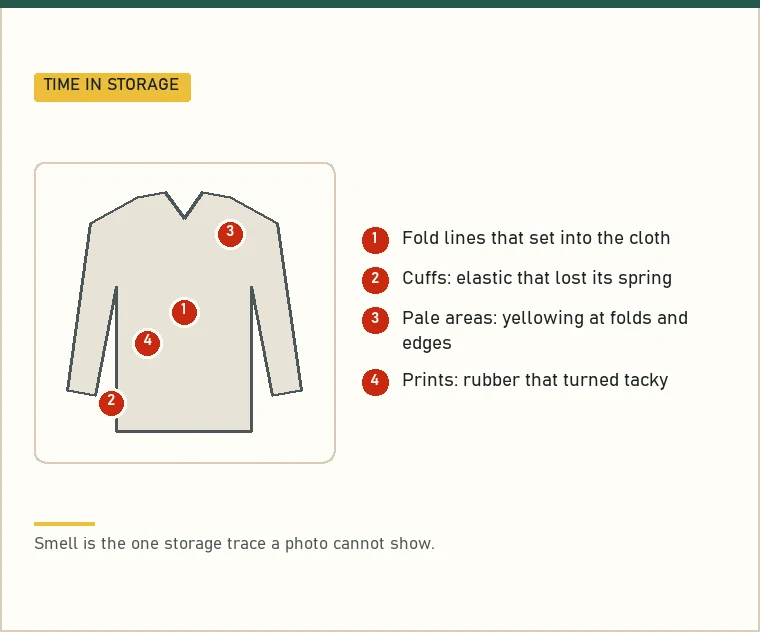
Unworn does not mean unchanged. Garments folded in a warehouse for a long time keep their fold lines, sometimes permanently on synthetic cloth. White and pale cloth can yellow along exposed edges and folds, especially in plastic bags. Elastic in waistbands and cuffs slowly loses its spring. Rubberised prints can turn tacky, and down jackets packed tight can take a while to recover their loft.
A photograph cannot establish smell or explain its cause. Ask about storage and any reported odour, but do not assume it will wash out or that washing is an appropriate remedy. Include unresolved condition concerns in the decision before shipping.
How much any of this matters depends on the cloth. A cotton tee two seasons old is close to new; a pair of white trainers kept in a humid store can have yellowed soles. Ask how long the stock has been held and look for daylight photos of the palest part of the piece.
Reading the seller's words on a clearance page
Clearance pages tend to be wordy, and only some of the words describe goods. Lines such as "older style", "warehouse stock", "last sizes" and "slight storage marks" are condition and worth reading closely. Lines that announce a deadline or a quantity, such as "this week only" or "last few", are about the sale, not the item, and this site leaves them aside.
Some clearance pages also carry the seller's own pre-payment statement about what happens after the sale. That is the seller speaking before you pay, not a description of the goods, and it is not read here.
The useful habit is to copy the condition lines into your own note before ordering. If the warehouse photos later show fold marks, you want to know whether "slight storage marks" was on the page when you bought.
Questions for a clearance lot
Is the photo the exact colour and style I am choosing? Which sizes are left? Is this fresh stock or stock that has been in storage, and for roughly how long? Any yellowing, fold marks or smell? Those four questions cover both labels on this page.
The CNFans warehouse check treats a clearance piece like any other order, looking at defects, size and colour. Yellowing and fold lines can show in its photos; smell and elastic cannot, so those two are worth settling with the seller first.