
Checked 19 October 2026
The last piece in stock, and the questions that come with it
One unit left can mean a perfect leftover or the piece that did all the work. The label does not say which; the seller can.
A last piece on the condition scale
On the condition scale, 孤品 (last piece) usually covers "New, sizes thinning out" to "Handled: shot, tried on or shown". The four points below are the short version of this page; the sections after them go into each one.
What usually differs. The listing describes a lone or unusual piece. Confirm its actual availability and history; the word alone proves neither rarity nor condition.
What the CNFans defect check tends to do. The wording claims a remaining or unusual unit; it does not prove live inventory or that no remedy is available. Match the order and unit photos, then ask about the available response to any discrepancy.
Photos that show it. Photos of this exact unit, not the catalogue images, with the size label readable.
Questions before you pay. Is this the unit in the photos? Was it on display, tried on or returned before? Does the size label match the size listed?
The last piece in stock
孤品 means a lone piece: the only unit left. Listings also say 仅剩一件 (only one left), 最后一件 (the last one) or show a stock counter that reads one. On clothing it usually means the end of a size or colour, and the price drops because a single unit is awkward to keep listing.
A last piece can be perfectly new. It can also be the unit that did a job before it was left over: the one on the mannequin, the one used in the photos, the one an earlier buyer sent back. The label does not say which, and the seller may not volunteer it.
On the condition scale a last piece spans a wide band, from "new, sizes thinning out" to "handled", because the same word covers all those histories.
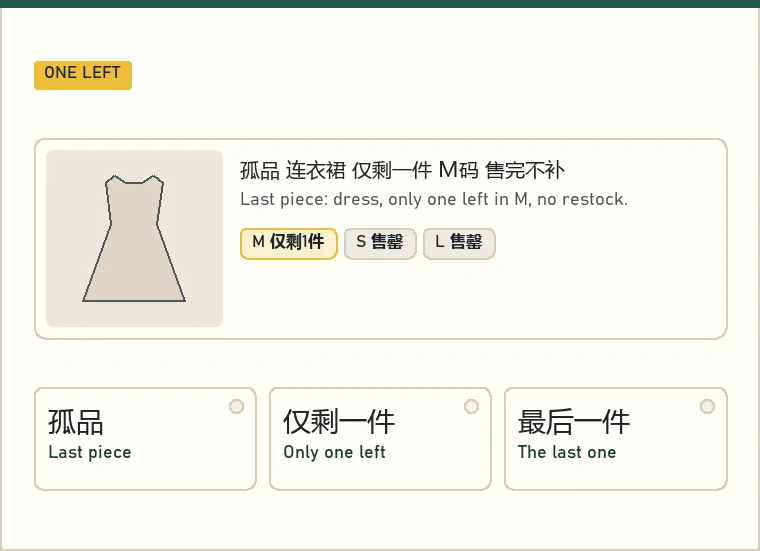
Two meanings of the same word
In clothing, 孤品 is a stock word. In collectibles it is a rarity word, closer to "one of a kind", and that second use is restricted. Taobao's industry rule for curios and collectibles, modified on 8 October 2026, says sellers may not, without certification, use descriptions that imply a grade, and its examples include 绝品, 孤品, 完美品 and 稀缺款.
孤品 can describe a lone remaining unit or be used as a claim of rarity. Neither the word nor a counter proves current inventory or uniqueness. Confirm the selected unit and condition with the seller before treating it as a last chance.
Either way, the word says nothing good or bad about condition. It only says there is no second unit, which changes how much the photos of this one are worth.
Which unit you are buying
With stocked goods you buy one of many identical units and the listing photos stand in for all of them. With a last piece you buy one specific unit, so the useful photos are of that unit. Ask whether the photos show it, and if not, ask for one.
Three histories are worth asking about directly. Was it on display? Then read the display page for what that leaves. Was it used for the listing photos? Then it may have shoot wear like a sample. Was it returned by an earlier buyer? Then it may have been tried on, and its packaging opened.
None of those histories makes the piece a bad buy. They make it a different buy from the new unit in the photos, and the price usually reflects that.
When there is no second unit
If the CNFans warehouse check turns up something on a stocked item, a seller can usually send another unit. On a last piece there is no other unit to send. That does not change what the check looks for; it changes what you can do with the result, and it is a good reason to settle questions with the seller before paying rather than after the photos arrive.
Match the warehouse record to your ordered option and the seller’s description. A mark is evidence about the photographed unit, but it does not prove that no replacement exists. Ask whether a return, replacement or other remedy is available before deciding whether to ship.
Questions for a last piece
Is this the unit in the photos? Was it on display, used for photos, tried on or returned before? Does the size label match the size listed? Can you send a photo of the label and of the front in daylight? Four questions, and the last one often answers the other three.
Keep the answers next to your order. When the warehouse photos arrive, a last piece is the easiest kind of markdown to check, because you already know exactly what the single unit should look like.