
Checked 19 October 2026
Flawed listings: the fault a seller shows you, and the one it leaves out
A flaw label is the most honest markdown reason there is, because it names the problem. It is also the one that depends most on how well the seller described it.
Where a flaw label sits on the condition scale
On the condition scale, 瑕疵 (flawed) usually covers the zone "A named fault, often a single piece". The four points below are the short version of this page; the sections after them go into each one.
What usually differs. A specific fault the seller admits to: a mark, a pulled thread, a misprint, a seam that wanders, a pinhole. The rest of the piece is usually new. Some listings point to the spot; plenty only say that a fault exists.
What the CNFans defect check tends to do. Compare the named fault and selected condition with photos linked to your order. Ask for the affected area and any other known damage. Disclosure does not automatically settle every remedy or show that the warehouse inspected the specific spot.
Request a close-up with a ruler or another clear scale, plus a wider image locating the same spot. A flat lay may reveal some faults and hide others; the request should name the concern rather than assume a particular angle will catch everything.
Questions before you pay. Where exactly is the fault, and how large? Is it the only one? Is the photo of this unit or of a similar one? Will it wash out, or is it permanent?
Flaws the seller discloses, and flaws left unsaid
瑕疵 means a flaw, and on a listing it means the seller is telling you about one. Variants you will see include 微瑕 (a slight flaw), 瑕疵品 (a flawed item) and 处理品, a word Taobao's own dispute rules for footwear and jewellery use for goods a seller marked as having a quality defect at the time of sale. The price drop is the seller's side of the bargain; the disclosure is yours.
Disclosure is not a favour. Taobao's quality management rule, first in force on 3 November 2022, asks sellers to state quality information in full when they publish an item, and its list names grade, condition and flaws. The same rule asks that the title, the images, the attributes and the detail section agree with each other, and that the description is kept up to date. Read in that light, a listing that says 瑕疵 in the title and shows nothing in the photos is only half finished.
Disclosed flaws come in two strengths. The strong version points: a red circle on a photo, an arrow, a sentence such as "small mark on the left cuff, about the size of a grain of rice". The weak version waves: "minor flaws, does not affect wear", with no location and no photo. Both are disclosures. Only the first gives you something to check the warehouse photos against.
Common faults on clothing, and where they usually sit
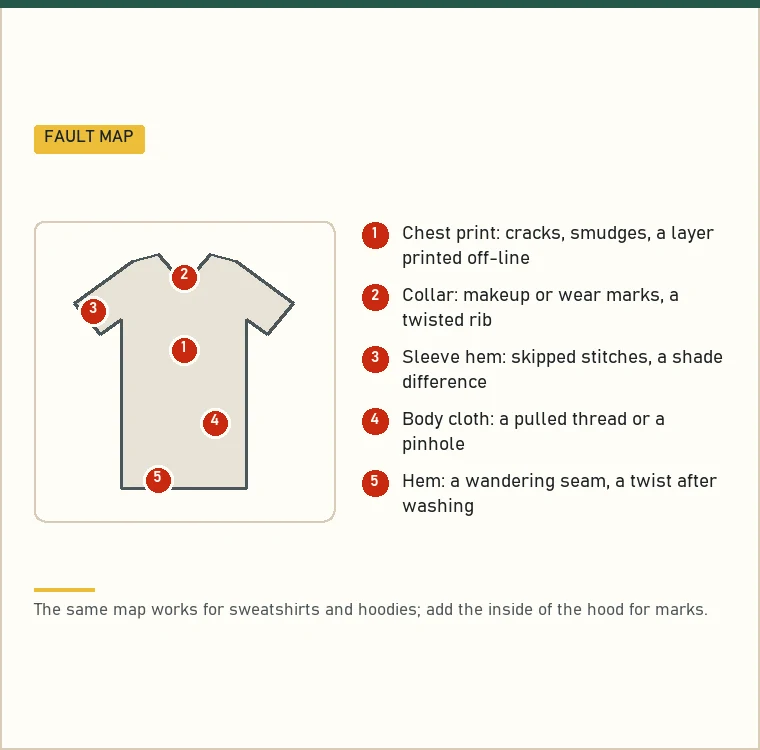
Most faults on a markdown garment come from production or from handling, and each kind has favourite places. Print faults sit on the chest and back of tees and sweatshirts: a crack in a thick print, a smudge, one colour layer printed slightly off the others. Weaving and knitting faults show as a pulled thread (勾丝) or a thin line across the cloth. Sewing faults sit on seams and hems: skipped stitches (跳线), a seam that wanders, a hem that twists after one wash.
Marks sit where hands and faces go: cuffs, collars, the front of a hood, the area around pockets. Dye problems show as one panel a shade away from its neighbour, often a sleeve against the body, because panels are sometimes cut from different rolls. Hardware faults are on zips, snaps and buttons: a zip that catches, a snap that does not close, a missing spare button.
Knowing the usual spots tells you where to look in a photo, and which photo to ask for when the seller has only written a sentence.
A flaw photo that proves something
A useful flaw photo answers three things at once: where the fault is, how large it is, and whether it is on this unit. The first needs a wider frame that shows the whole sleeve or panel. The second needs something of known size in the picture: a coin, a ruler, a fingertip. The third needs a detail that ties the photo to the piece you will receive, such as the same tag or the same fold, which is why sellers with several flawed units sometimes photograph each one.
Light matters as much as framing. A faint mark that shows under a desk lamp can vanish under a ring light, and a shade difference between panels may only appear in daylight. When a seller sends a close-up that is so tight you cannot tell which part of the garment you are looking at, ask for the same spot from further away. When the only image is a polished flat lay, ask whether the fault is visible in it at all; often it is not.
Words that travel with a flaw label
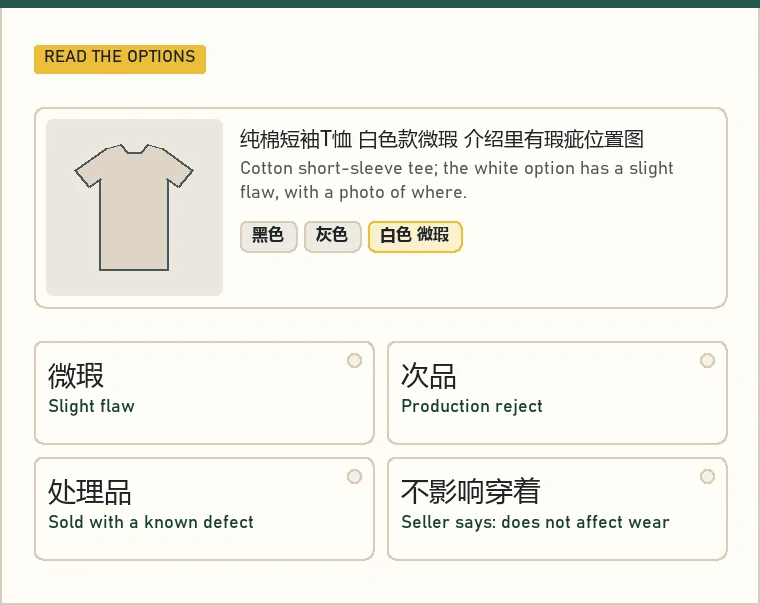
Flaw listings have their own small vocabulary. 不影响穿着 says the fault "does not affect wear". It is the seller's view of the fault, not a measurement, so treat it as a claim to test. 轻微 means slight. 次品 is blunter than 瑕疵 and usually means a reject from production. 处理品 is the old shop word for goods sold off with a known defect.
Some listings carry a fault label on only one option in the menu, for example a single colour that came out of the dye bath a shade off, with the other colours sold at full price. Read option names as carefully as the title: a cheaper option can be cheaper because it is the flawed one.
Notes that sit in the detail images, such as a seller's general warning about colour or measuring, are a different thing: they are the seller speaking about every sale, not describing this fault, and this site does not read them as condition.
Questions that pin a flaw down before you pay
Ask where the fault is, how large it is, whether other faults are known, and whether the picture shows the unit offered. Those answers improve the record but cannot establish complete disclosure or guarantee that a mark is removable. Keep any uncertainty visible before deciding to buy.
How to judge a seller on a flaw listing has less to do with the shop's ratings than with the answer itself: specific beats reassuring, a photo beats a sentence, and "I will check the unit" beats an instant reply that could have been pasted. Keep the answer with your order record. When the warehouse photos come back, it is the yardstick.